

UK Property Market Update March 2026: Boom Meets Storm
Chris Hunter • April 3, 2026

UK Property Market Update: March 2026 - Sharp Price Growth Meets Geopolitical Uncertainty


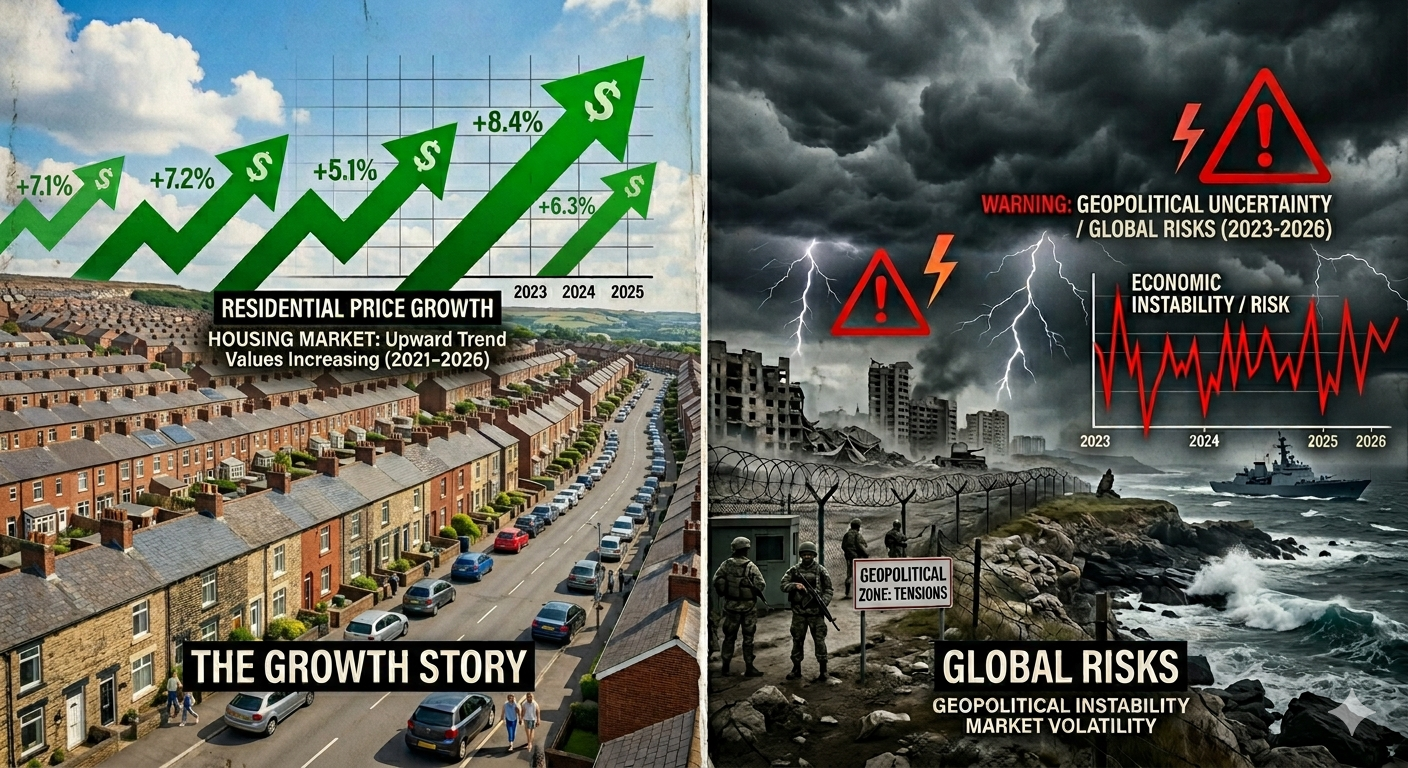
March 2026 has delivered one of the most dramatic months for the UK property market in recent memory. Whilst house prices surged at their fastest rate in almost 18 months, a perfect storm of geopolitical events has cast serious doubt over what comes next.


The Numbers Tell Two Stories

The headline figures paint a picture of unexpected strength. According to Nationwide, the typical UK home jumped 0.9% in value during March alone - the sharpest monthly increase since December 2024. This surge pushed the average house price to £277,186, with annual growth accelerating from a modest 1% in February to 2.2% by March's end.


These numbers surprised economists who had predicted more modest growth of around 0.6%. Coming on the back of official HM Land Registry data showing the average UK home at £268,000 in January (with more conservative annual growth of 1.3%), March's acceleration represents a significant shift in momentum.


Regional Winners and Losers

Not every corner of Britain shared in March's good fortune. The strongest performers continue to be found outside London's orbit:

Northern Ireland leads the charge with eye-watering annual growth of 9.5%, pushing average prices to £225,269. The North West of England follows with solid 3.1% growth to £229,173, whilst Scotland maintains steady progress at 3% annual growth.


London's story remains more complex. Despite showing the strongest monthly increase of 0.8% in January's government data, the capital faces headwinds with annual declines of 1.7%. The government statistics reveal stark variations within London itself - whilst areas like Redbridge posted 7.2% annual growth, prestigious locations like Kensington and Chelsea saw values tumble 10.8%.


The outer South East and East Anglia continue their struggles, with both regions posting annual declines according to official data.


The Iran Crisis Changes Everything

Just as the market appeared to be finding its feet, the US-Israel war on Iran erupted, sending shockwaves through financial markets that immediately hit British homebuyers where it hurts most - their mortgage rates.


Two-year fixed rates rocketed from 4.83% to 5.77% during March alone. Five-year fixes jumped from 4.95% to 5.7%. These aren't gradual increases - they represent the biggest mortgage rate upheaval since the aftermath of Liz Truss's mini-budget in 2022.


The root cause lies in changed expectations for Bank of England policy. Where markets previously anticipated two base rate cuts this year, they now expect three rate rises from the current 3.75%. This dramatic reversal reflects fears that the Middle East conflict will drive energy costs higher, forcing the central bank to prioritise inflation fighting over growth support.


Activity Levels Tell the Real Story

Behind March's price surge lies a market still struggling with fundamental challenges. The latest government data reveals transaction volumes remain deeply depressed - just 43,013 sales completed in England during November 2025, compared to 70,691 the previous year.


Recent surveys confirm this malaise continues. New buyer enquiries fell sharply to a net balance of -26% in February, down from -15% the previous month. Mortgage approvals, whilst showing some signs of life with 60,000 recorded in January, remain well below historical norms.


Estate agents report viewing numbers beginning to soften as the mortgage rate surge takes hold. "We are seeing a slight softening in viewing numbers as some buyers pause to assess the situation," notes Amy Reynolds from Richmond-based Antony Roberts.


Rental Market Shows Signs of Balance

One bright spot emerges in the rental sector, where supply and demand dynamics finally show improvement. Competition among tenants has fallen to six-year lows, with enquiries per property dropping from 6.5 to 4.8.


This cooling reflects both increased supply (up 11% year-on-year) and reduced demand (down 14%). The improvement appears driven by more renters successfully moving into home ownership, freeing up rental properties for others.


Annual rental growth has slowed to 1.9%, down from 2.8% previously. However, northern cities continue outperforming, with Liverpool and Newcastle posting robust rental growth of 4.6% and 4.5% respectively.


First-Time Buyers Seize the Moment

Despite broader market challenges, first-time buyers have emerged as unexpected winners. Bank of England data shows their share of new mortgage lending hit 31.4% in Q1 2025 - the highest proportion since records began in 2007.


This surge partly reflects government schemes supporting first-time purchases, but also suggests younger buyers are acting decisively whilst they can still secure financing. High loan-to-value lending (above 90%) reached 6.7% of all advances - levels not seen since the 2008 financial crisis.


Property Investment Perspective

For property investors, March 2026 presents both opportunity and significant risk. The price surge offers hope that the market retains underlying strength, particularly in regions showing consistent growth like the North West and Scotland.


However, the mortgage rate environment fundamentally changes investment economics. Buy-to-let investors face particular pressure, with their share of new lending falling to just 8% as higher rates squeeze rental yields.


Investors with cash positions may find genuine opportunities emerging as stretched borrowers are forced to sell. The key will be focusing on areas with strong rental demand and avoiding markets overly dependent on mortgage-driven demand.


Looking Ahead: Uncertainty Rules

March 2026 will likely be remembered as the month when optimism met reality. The strong price performance demonstrates the market's underlying resilience, but the mortgage rate shock threatens to derail any sustained recovery.


Much depends on how the Middle East situation develops. A swift resolution could see mortgage rates retreat, allowing the market's positive momentum to continue. Prolonged conflict, however, could push rates even higher, potentially triggering the market correction that many have long predicted.


The rental market's improvement offers hope that housing demand remains robust across different sectors. Combined with government data showing increased first-time buyer activity, this suggests the market retains fundamental strength.


For those considering property transactions in the coming months, timing has rarely been more critical. Sellers might find March's price surge represents a window of opportunity before higher mortgage rates fully impact buyer demand. Buyers, meanwhile, may want to complete purchases quickly before rates climb further.


March 2026 has reminded us that in property, as in life, nothing stays the same for long. The market's ability to navigate the months ahead will test every participant - from first-time buyers to seasoned investors.


Data sources: Nationwide Building Society, HM Land Registry UK House Price Index, Bank of England Mortgage Lenders and Administrators Statistics, RICS, Zoopla, Retire Invest residential property review.


By Chris Hunter March 6, 2026
February 2026: A Market at the Crossroads
By Chris Hunter February 14, 2026
Your monthly insight into the UK property landscape 📈 Key Headlines This Month House prices rise 2.5% annually to £271,000 (November 2025 data) Bank of England holds base rate at 3.75% - but vote was closer than expected Property market shows early recovery signs after challenging autumn period North East leads price growth while London continues to struggle 🏠 House Prices: Steady Growth Returns The UK property market delivered encouraging news in January, with government figures showing house prices increased by 2.5% annually to reach an average of £271,000 by November 2025. This marks a notable improvement from October's 1.9% growth rate, suggesting the market is finding its feet after months of uncertainty. Regional Performance Spotlight Strongest Growth: North East: 6.8% annual increase Scotland: 4.5% annual growth Northern Ireland: 7.1% quarterly rise Challenging Areas: London: -1.2% annual decline (improving from -2.6% in October) Wales: 0.7% modest growth England average: 2.2% steady increase The regional divide remains clear, with northern areas continuing to outperform the capital and southern regions where affordability pressures persist. 🏦 Interest Rates: Holding Pattern with Hidden Optimism February brought mixed signals from the Bank of England. The base rate remained at 3.75% as expected, but the voting split revealed underlying optimism for borrowers. The surprise: Four out of nine committee members voted for a cut to 3.5%, suggesting future reductions remain likely. What This Means for Mortgages Mortgage rates have edged up slightly in early February, with several major lenders including Nationwide, Santander, and Virgin Money raising rates by up to 0.19 percentage points. However, rates remain at their lowest levels since 2022 following the recent price war. Current Best Rates: 2-year fixed: From 3.55% (60% LTV) 5-year fixed: From 3.73% (60% LTV) Average rates still significantly lower than early 2025 📊 Market Sentiment: Green Shoots Emerge Industry professionals are cautiously optimistic about 2026. The Royal Institution of Chartered Surveyors (RICS) reported the least negative readings in several months during January. Key Indicators Improving: Buyer Activity: New buyer enquiries: -15% (improved from -21% in December) Agreed sales: -9% (best reading since June 2025) Future Expectations: 35% of surveyors expect sales increases over the next 12 months 43% anticipate price rises over the coming year Strongest optimism since December 2024 🏠 Rental Market: Cooling But Still Pressured Private rents continue rising but at a slower pace. Average UK monthly rents reached £1,368 in December 2025, representing a 4.0% annual increase - down from 4.4% the previous month. Regional Rental Highlights: Highest Growth Areas: North East: 7.9% annual increase Wales: 5.7% growth Northern Ireland: 5.7% rise Moderating Growth: London: Just 2.1% increase (down from 2.8%) Scotland: 2.8% growth England average: 3.9% rise 💡 What This Means for Property Investors January's data suggests the market may be entering a gradual recovery phase after the challenging autumn period. However, several factors warrant close attention: Opportunities: ✅ Regional markets like the North East showing strong fundamentals ✅ Mortgage rates remain competitive despite recent increases ✅ Market confidence slowly returning among professionals ✅ Buyer choice at highest levels in 18 years Considerations: ⚠️ Economic uncertainty around inflation and interest rate trajectory ⚠️ Regional variations remain significant ⚠️ Affordability pressures particularly in southern markets ⚠️ Political factors may impact future market conditions  🔍 Looking Ahead: February & Beyond The property market appears to be finding its footing after the autumn slowdown. While challenges remain, particularly around affordability and economic uncertainty, the underlying fundamentals suggest a gradual strengthening through 2026. Key factors to watch: Bank of England decisions on interest rates Mortgage lender competition and pricing Regional market performance variations Economic data and inflation trends For property professionals and investors, the message remains clear: cautious optimism with careful attention to local market conditions and funding costs.
More Posts